NEO braces.com


BRACES AND YOU
Click HERE to see patients Dr Z has treated
FREQUENTLY ASKED QUESTIONS ABOUT BRACES
What is orthodontics?
Orthodontics is the branch of dentistry that specializes in the diagnosis, prevention and treatment of dental and facial irregularities. Braces are appliances or devices used to make these corrections.
What is an orthodontist?
An orthodontist is a specialist who has completed an advanced education program following dental school to learn the special skills required to manage tooth movement and guide facial development.
Why should you choose an orthodontic specialist?
Teeth and sometimes faces are permanently changed by orthodontic treatment; therefore, it is very important that the treatment is done right the first time. Dr Z has undergone 3 additional years of full-time specialized training in orthodontics in a university-based graduate residency program after receiving his doctorate from dental school, and dedicates his entire professional life to treating orthodontic problems only. Board certification by the American Board of Orthodontics (ABO) takes that education one step further. The ABO is the only board-certifying organization for orthodontics that is accredited by the American Dental Association (ADA). Dr. Z is a very rare doctor board-certified by both the American Board of Orthodontics and European Board of Orthodontists (EBO).
Are braces necessary?
No. They are elective but people seldom grow out of the more severe problems.
What are the early warning signs of a bad bite?
•Upper front teeth protrude excessively over the lower teeth, or are "bucked".
•Top front teeth cover more than 25% of the bottom front teeth when the back teeth are biting together (deep bite).
•Top front teeth grow in behind the bottom front teeth (underbite).
•A space exists between the top and bottom front teeth with the back teeth biting together.
•Crowded or overlapped teeth or extra teeth.
•Baby teeth are slow falling out.
•The centers of the top and bottom front teeth don't line up.
•Finger or thumb sucking habit continuing after 6 years of age.
•Difficulty chewing.
•Teeth wearing unevenly or excessively.
•Jaws that shift off center when the teeth bite together.
•Spaces between teeth.
•Teeth or smile often hidden by hands.
When should I look for the early warning signs?
It is most important to examine your child's teeth as the first permanent teeth grow in.
Will additional jaw growth allow self-correction of crowded teeth seen in an 8-year-old child?
No. The space available for the front teeth does not increase after the permanent 6-year molars erupt. In most people, the space available for the front teeth decreases with increasing age.
What are some possible benefits of orthodontics?
•A more attractive smile.
•Reduced appearance-consciousness during critical development years.
•Better function of the teeth.
•Possible increase in self-confidence.
•Increased ability to clean the teeth.
•Improved force distribution and wear patterns of the teeth.
•Better long-term health of teeth and gums.
•Guides permanent teeth into more favorable positions.
•Reduces the risk of injury to protruded front teeth.
•Aids in optimizing other dental treatment.
When should orthodontic treatment be started?
The most confusing question for most parents, and some general dentists, is when to actually start treatment. The objective is to treat at the time when it will minimize treatment duration, achieve a normal profile, and get the best long term, stable result. Orthodontic treatment can be started at any age. Many orthodontic problems are easier to correct if detected at an early age before jaw growth has slowed. Early treatment may mean that a patient can avoid surgery and more serious complications.
Some orthodontic problems start developing at the age of 6 to 7 years, and it is usually a good time to get an initial consultation, especially if the parent or general dentist suspects that a problem may be developing. Though no active treatment may be initiated at this time in most cases, some problems may need to be intercepted to prevent them from later developing into complicated situations. An example of an indication to start early treatment is the presence of a cross-bite of the front or back teeth. The American Association of Orthodontists recommends that every child first visit an orthodontist by age 6 or 7, or earlier if a problem is detected by parents, the family dentist, or the child's physician.
What is Phase I and Phase II treatment?
Phase I, or early interceptive treatment, is limited orthodontic treatment (i.e. expander or partial braces) before all of the permanent teeth have erupted. Such treatment can occur between the ages of six and eleven. This treatment is sometimes recommended to make more space for developing teeth, correction of crossbites, overbites, underbites, or harmful oral habits. Phase II treatment is also called comprehensive treatment because it involves full braces when all of the permanent teeth have erupted, usually between the ages of eleven and thirteen.
How many people receive orthodontic care?
Approximately 4 million people are in braces in the USA at any one time.
Would an adult patient benefit from orthodontics?
Yes. If the teeth and gums are healthy, age is not a factor. Everyone wants a beautiful and healthy smile. About 30% of orthodontic patients are adults. Dr. Z has successfully treated a number of patients over 40 years of age.
Do you need a referral from your family dentist to see an orthodontist?
You don't need a referral from your family dentist. Word of mouth recommendations from friends and families of existing patients is often the primary way orthodontists meet new patients. Spread the word if you like your orthodontist!
What causes crooked teeth?
Heredity is the main cause although local factors such as finger sucking, high cavity rate, gum disease, trauma and premature loss of baby teeth can also contribute to a bad bite.
Why should I have my teeth straightened?
Poorly arranged teeth can sometimes break more easily and can trap food particles that cause tooth decay and gum disease. They can also lead to poor chewing and digestion, which can be bad for your overall health. Finally, poorly arranged teeth detract from your smile, which is one of the more important features of your face. Self-confidence, especially during the very important adolescent formative years, can be affected.
How do braces straighten crooked teeth?
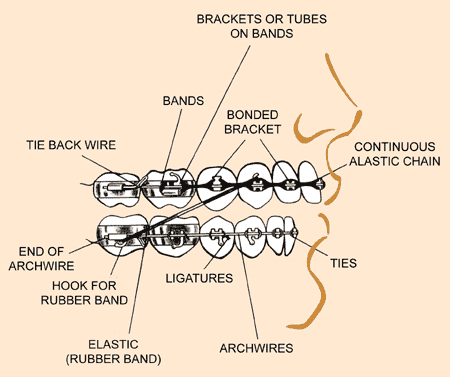
Braces use steady, gentle pressure over time to move teeth into their proper positions. They don't look like they're doing much just sitting there, but in fact, during every moment of your orthodontic treatment, there's something happening in your mouth, something good for you. The brackets we place on your teeth, and the main archwire that connects them, are the two main components. The bracket is a specially manufactured high-precision metal or ceramic medical device that we glue on each tooth. Then we bend the archwire to reflect your 'ideal" bite, what we want you to look like after treatment. The wire threads through the brackets and, as the wire tries to return to its original shape, it applies pressure to actually move your teeth. Picture your tooth resting in your jawbone. With pressure on one side from the archwire, the bone on the other side gives way. The tooth moves. New bone grows in behind. It may look like nothing is happening--but we're making a new smile here. Thanks to new materials and procedures, all this happens much quicker and with less discomfort than ever before. It's an amazing feat of modern engineering.
What do rubber bands do?
“Rubber bands” or “elastics” contribute a lot to straighter teeth. They are marvels of physics. Attached to your braces, elastics exert the energy force that creates the right amount of pressure to move teeth and aligns the two jaws so they can function together with one another. It's important to wear your elastics all the time and change them every day so the force is constant, which is good for the teeth. Even forgetting them for a day prolongs the length of treatment.
How long does orthodontic treatment take?
Treatment times vary on a case-by-case basis, but the average time is from one to two years. Actual treatment time can be affected by rate of growth and severity of the correction necessary. Treatment length is also dependent upon patient compliance. Maintaining good oral hygiene and keeping regular appointments are important in keeping treatment time on schedule.
Do braces hurt?
The placement of bands and brackets on your teeth does not hurt. Your lips and cheeks may need one to two weeks to get used to the braces on your teeth. Once your braces are placed and connected with the archwires you may feel some soreness of your teeth for one to four days –often patients refer to this as “pressure”.
Will braces correct TMJ or jaw joint problems?
Braces may or may not improve jaw joint problems. More conservative approaches should be tried first.
Will braces interfere with playing sports?
No. It is recommended, however, that patients protect their smiles by wearing a mouth guard when participating in any sporting activity. Mouth guards are inexpensive, comfortable, and come in a variety of colors and patterns.
Will braces interfere with playing musical instruments?
No. However, there may be an initial period of adjustment. In addition, brace covers can be provided to prevent discomfort.
Will orthodontics change my lifestyle?
You'll have to give up extremely hard and sticky foods including gum. These foods can get caught on the braces and pull the braces off. You will also have to spend a few extra minutes cleaning your braces after meals. But, for the most part, you'll find braces don't cramp your style. You'll still be able to sing, play your musical instrument, smile, play sports and of course, kiss.
Is orthodontic care expensive?
Well-timed orthodontic treatment to correct a problem is often less costly than the additional dental care required to treat the more serious problems that can develop years later. Treatment fees vary depending on the type of orthodontic problem, the type of appliances needed, and the duration of the treatment. Orthodontic fees have not increased as fast as many other consumer products. Fees for an initial consultation are… free.
When is the best time to schedule an initial consultation?
Early consultation allows the orthodontist to determine the optimum time for treatment to begin. In some cases, satisfactory results are unattainable once the face and jaws have finished growing. Seven years old is a good rule of thumb for a child unless you see a noticeable problem earlier. Early examination often permits maximum improvement with the least amount of time and expense.
Should I see my general dentist while I have braces?
Yes, you should continue to see your general dentist every six months for cleanings and dental checkups.
Getting Started:
•Your free initial consultation will take a few minutes in the orthodontist’s office. Please call (603) 742-4735 to make an appointment with Dr. Z.
•You will be asked what you want to change about your smile and what questions you have about braces.
•Your orthodontist will do a detailed examination of your face, jaws and teeth.
•Your orthodontist may recommend records (x-rays, photos and impressions of the (teeth) in order to plan treatment.
•Dr. Z will try to answer the following questions: Can the problem be corrected? How long will it take? How much will it cost? When should it begin? What kind of appliance or device will be used? What does the patient need to do for treatment to succeed? What kind of final result can you expect? After active treatment, what will be needed to maintain the results?
•Your orthodontist will tailor treatment specifically for you.
•Your orthodontist will indicate if other dental care is necessary before starting orthodontic treatment.
What To Expect:
•Experiences similar to friends who have worn braces.
•Special instruction on how to clean your teeth with braces.
•Adjustment of your braces approximately every 4-8 weeks. Routine dental and dental hygiene appointments must be maintained.
•Mild tooth soreness during the first week in braces and after adjustment appointments.
•A treatment time of 6-36 months depending on the complexity of treatment.
•A period of retainer wear will follow removal of your braces.
•A discussion of the effect of wisdom teeth on the orthodontic result.
•The degree of success is almost always a reflection of a person's cooperation during treatment and retention. Active patient participation is always essential for success.
New Techniques:
•Space age low force wires that remember their original shape allowing teeth to move faster without kinking.
•New-generation low-friction self-locking “Damon System” braces are used by Dr. Z.
•Clear, tooth-colored braces.
•Totally Invisible braces (Simpli5, Invisalign) may be used with certain patients.
•Braces glued to teeth with adhesives that contain cavity-fighting fluoride.
•Combined treatment of orthodontics and surgery for abnormalities that are beyond the capabilities of orthodontics alone.
Preserving Your Smile:
•Brush after meals with a fluoride toothpaste.
•Minimize sodas, sports drinks, sweet drinks, chocolates, sweets, potato chips, which stick to your braces, are difficult to clean, and cause white spots (decalcification) on the tooth surface.
•Have your teeth examined and professionally cleaned by your family dentist at least every 6 months.
•Wear your retainer after your braces are removed to keep your teeth from moving out of alignment.
First Aid for Braces:
•If a wire is causing irritation, try pushing the wire away from the area being irritated using the eraser end of a pencil or the blunt side of a spoon. If the wire cannot be tucked in, cover the end of the wire with a small piece of wax, a cotton ball, or a piece of sugarless chewing gum, and call us as soon as possible to fix the problem. Cutting the wire should only be done as a last resort.
•If your teeth are sore after an orthodontic appointment, take a painkiller such as acetaminophen, ibuprofen or aspirin, unless you are allergic to them. Rinsing your mouth with a teaspoon of salt dissolved in a glass of warm water can also be soothing. If your teeth are suddenly sore in between appointments, give your orthodontist a call. It is unusual for the teeth to become sore several weeks after your last office visit.
•If food becomes stuck between your teeth, use your toothbrush without toothpaste, to dislodge the food particles.
•If a piece of your appliance breaks, save the piece and call your orthodontist to schedule a repair visit.
•If you swallow a piece of your appliances, try to remain calm. Most of the time it will go in the stomach and pass out of the body in a bowel movement. Eating salads and/or whole-wheat cereal helps. Please call the office if you feel that you have swallowed anything by accident.
•If a retainer cracks, bring it to your orthodontist for a professional repair.
•If a permanent tooth feels excessively loose, call your orthodontist to discuss the movement. A little movement is normal when wearing braces, but if a tooth can be pushed upward towards the gums with just finger pressure that is unusual.
NEW ENGLAND ORTHODONTICS PLLC - All rights reserved